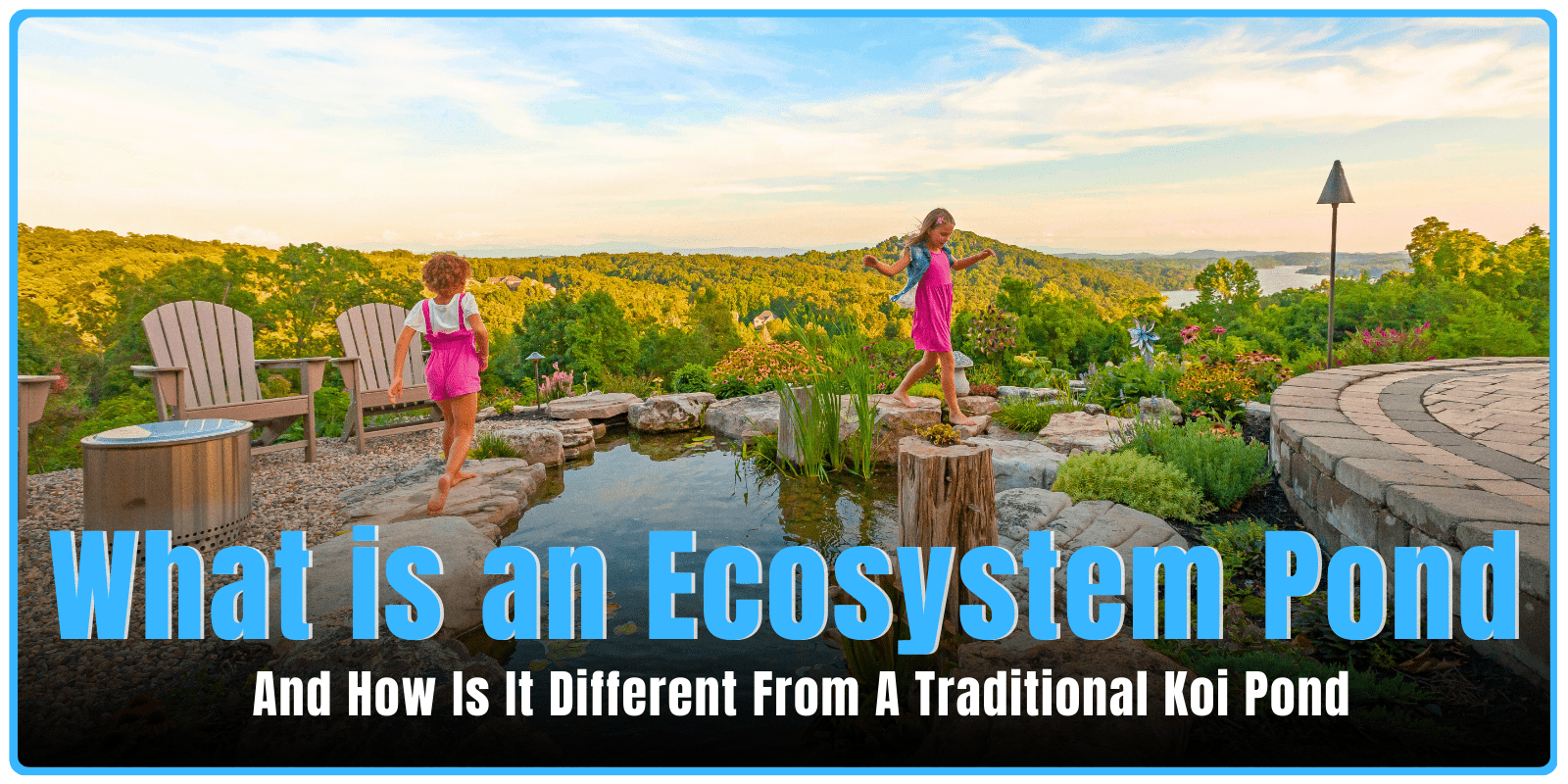
An ecosystem pond is a natural-style water feature designed to mimic how water stays clean in nature. It uses rocks, gravel, aquatic plants, fish, and beneficial bacteria to create balance — instead of functioning like an outdoor aquarium built primarily for raising show koi.
📋 Jump to a Section
- What Is an Ecosystem Pond (And Why I Think It Is the Best Type of Pond)?
- How Is an Ecosystem Pond Different From a Traditional Pond?
- Is An Ecosystem Pond Better For Koi Than A Traditional Pond?
- How Does An Ecosystem Pond Actually Work?
- Are Ecosystem Ponds High Maintenance?
- Additional Considerations With Traditional Koi Ponds
- Frequently Asked Questions
- Is an Ecosystem Pond Right for Me?
What Is an Ecosystem Pond (And Why I Think It Is the Best Type of Pond)?
I've been asked by people so many times over the years what defines an ecosystem pond and what makes it special or better than other types of ponds.
The actual definition of an ecosystem is a biological community of interacting organisms in their environment.
And that's exactly what an ecosystem pond is.
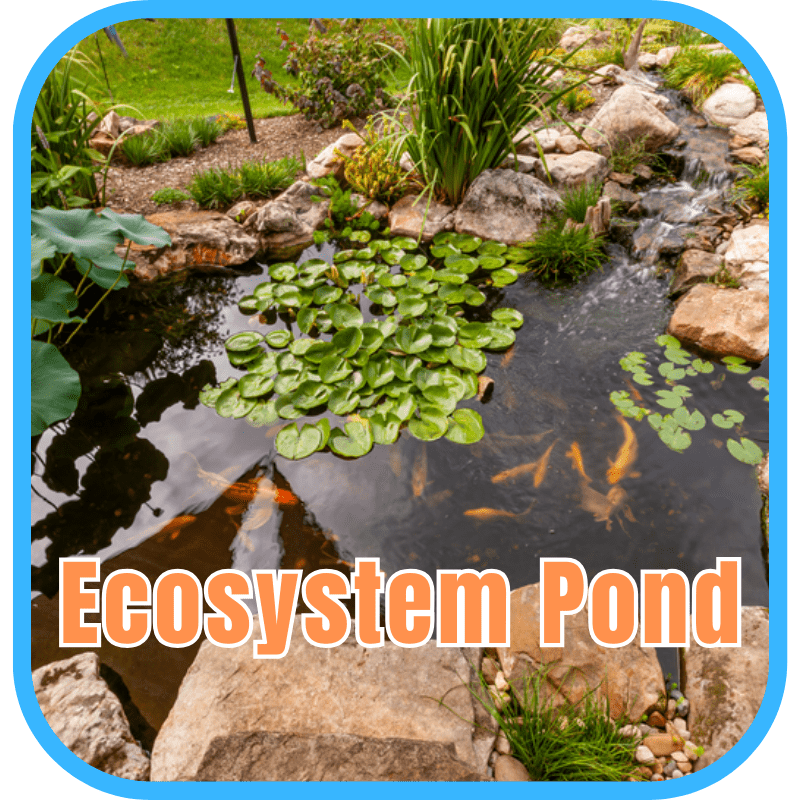
It's rocks. It's gravel. It's plants. It's fish.
It is a total mimicry of nature.
It's not just about one thing.
It's about the harmony of everything — all things working together inside of the ecosystem.
The more natural the design, the better the outcome and the easier the maintenance.
I realize the amount of information that's out there in the world about different types of ponds — and everybody says they're right.
The reality is, each one is completely different. But no pond is wrong.
My favorite has always been the ecosystem pond.
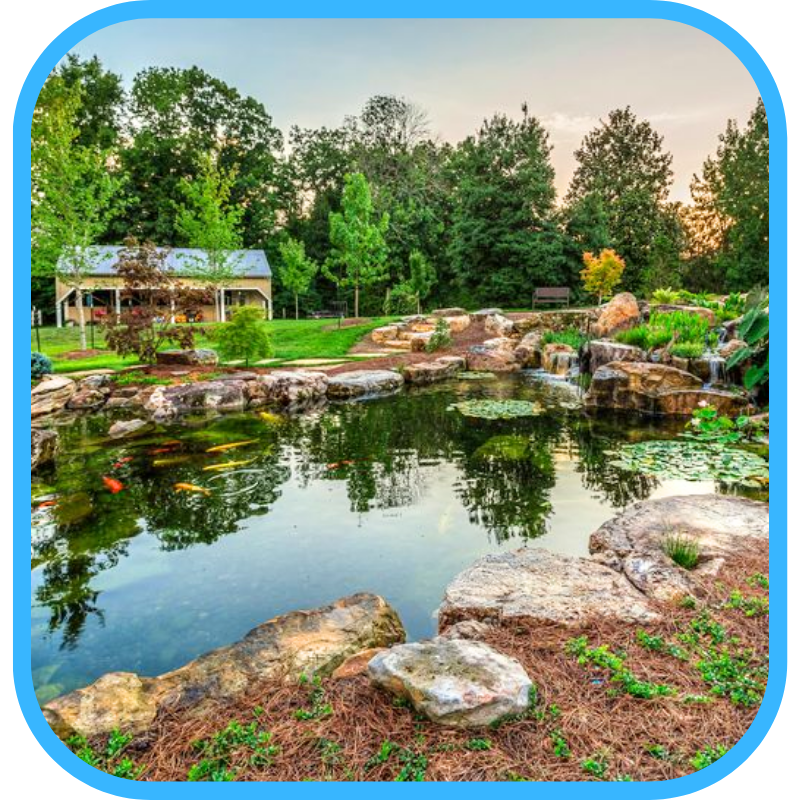
It's the way an ecosystem pond blends into a landscape.
The landscape fades into the marginal aquatic plantings.
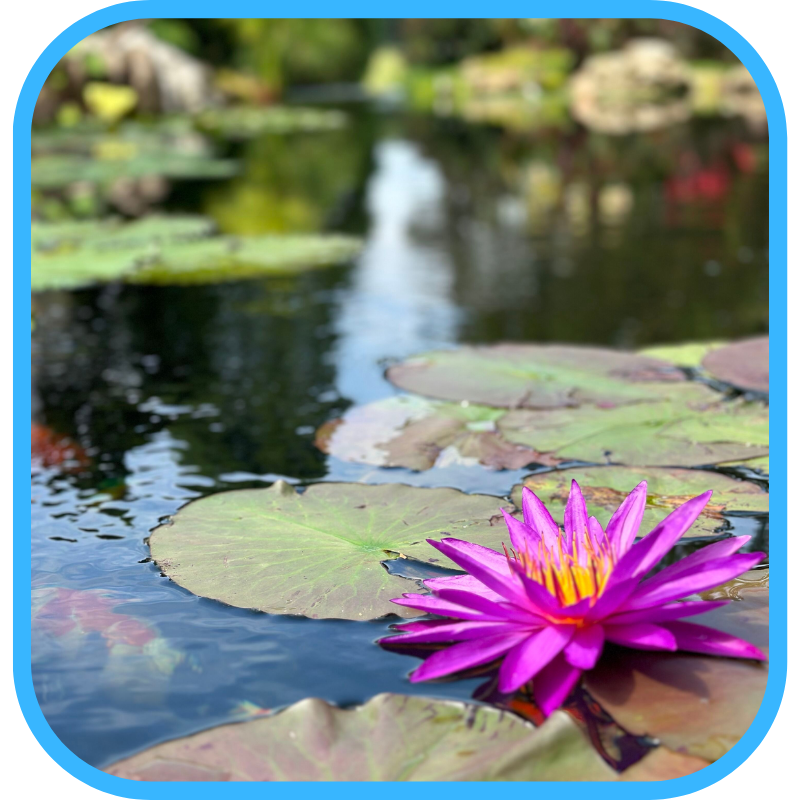
The lilies and the lotuses stretch across the surface of the water.
Fish swim throughout the pads trying to get your attention because they're begging for food like tiny swimming dogs.
It becomes a place where you find yourself wanting to go.
It provides a place for you to relax to the sound of the water.
You connect with yourself. You connect with your family and your loved ones. You connect with nature.
You might think this whole thing sounds corny.
But when we build a pond for people, it becomes the center of their world.
That's an ecosystem pond to me.
Not just water with fish swimming around — but a living, breathing, balanced piece of nature that becomes your favorite part of your day.
How Is an Ecosystem Pond Different From a Traditional Pond?
There's always been this battle between the koi people and the ecosystem pond people.
The koi crowd tends to lean toward what I would call a traditional pond setup.
What Is A Traditional Pond?
In my mind, it's a pond that is all about the fish.
A traditional pond is typically an outdoor aquarium. It's not meant to have aquatic plants. It's not meant to have rocks and gravel across the bottom. It usually includes exposed concrete or liner, sometimes stone coping around the edges, often more formal in design.
The filtration system looks a lot like a swimming pool filter. External pumps. Bottom drains. Sometimes a skimmer. Aeration systems.
If you are looking to grow championship koi, a traditional pond is the way to go. You don't raise award-winning koi in ponds with rocks and gravel because the fish can injure themselves. You want them in something closer to an aquarium where they can't get dents and dings.
And that's not bad. I've seen plenty of traditional koi ponds that are gorgeous. Amazing fish make for an amazing viewing experience.
But it's a different philosophy.
Who Is A Traditional Pond Really For?
There are typically two types of people drawn to a traditional pond.
One is the fish fanatic — someone who truly wants to raise and showcase koi at a high level.
The other is someone who sees that the construction process is simpler and often less expensive. A traditional pond doesn't require massive amounts of rock and gravel. It's essentially a hole with a liner in it, rock around the edges, more elaborate plumbing, and an external filter.
The build is simpler, and that can keep the cost lower, depending on who's building it.
Do Power Outages Cause Problems In Traditional Koi Ponds?
In a traditional pond, most of your beneficial bacteria live inside that external filter. It's dependent on fresh, oxygen-rich water constantly running through it.
When the power goes out, that filter has to hold its breath.
Those systems are very unforgiving when it comes to oxygen deprivation. Lose power in mid-summer for an hour, and you can lose most of your biological filter. That can lead to ammonia spikes, water quality issues, and stressed fish.
You can absolutely design around that with generators, aerators, and strategic planning. But most people don't. Most people install the system, turn it on, and walk away.
An ecosystem pond is different because the biological activity isn't concentrated in one external canister.
You still have mechanical filtration.
You still have biological filtration.
You still have a skimmer.
You still have a biofalls or wetland filter doing the heavy lifting.
But you also have beneficial bacteria living throughout the pond — in the rocks, gravel, and plants.
It's distributed.
That creates more forgiveness.
More time.
Less of a sledgehammer effect when something goes wrong.
Is An Ecosystem Pond Better For Koi Than A Traditional Pond?
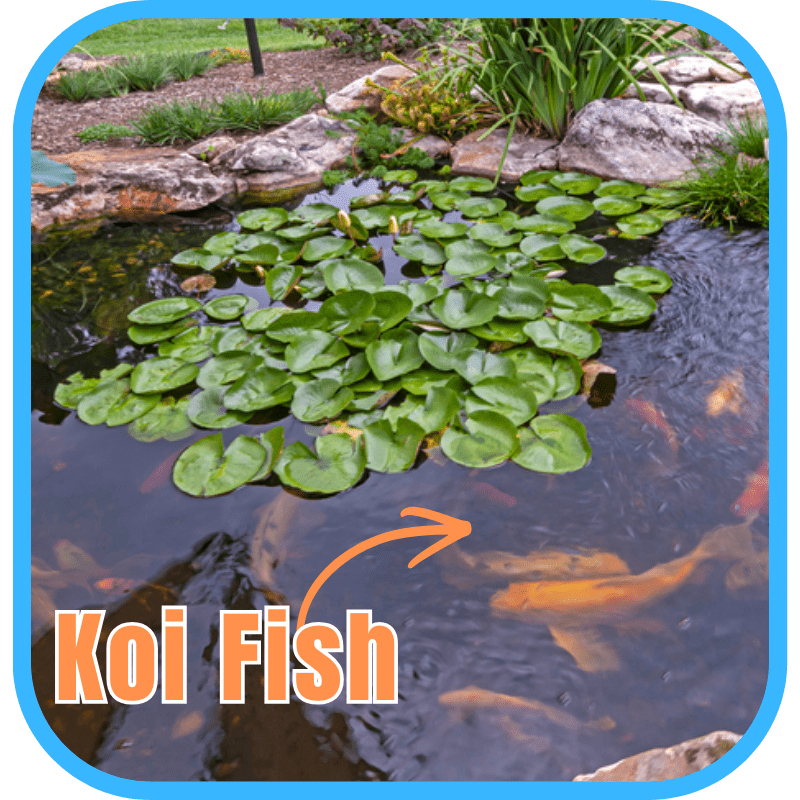
In an ecosystem pond, fish behave like fish.
Koi love to dig in the bottom. They love to filter through sand and gravel. They love to root around in what I call nature's organic soup — the biology that lives in the substrate. They chew on plants. They explore. They interact.
There's something for them to do.
Imagine being locked in a mall with things to explore versus being locked in a closet with nothing.
That's how I feel about putting koi in an outdoor fish tank.
It's not that it's wrong.
It's just a different experience.
At the end of the day, if I had to explain the difference standing in someone's yard, I'd ask:
Would you prefer an outdoor fish tank designed to raise champion fish?
Or would you prefer a natural, organic-looking water feature that blends into your landscape and makes you feel like it could be found out in the mountains somewhere?
That's the difference.
How Does An Ecosystem Pond Actually Work? (Simple Breakdown Of The Filtration System)
Everything sounds easy if you say it fast.
But the reality is, an ecosystem pond functions like nature.
It's that simple.
I've always told people, you're trying to recreate nature on your own terms. The closer you get, the easier your pond will be to take care of.
That's how an ecosystem pond works.
There aren't a lot of moving parts.
You have a skimmer box. That's your mechanical filter. The skimmer holds the pump inside it. It catches large debris like leaves and floating material. It's called a mechanical filter because it's the part you physically clean on a regular basis.
Inside that skimmer is the pump. The pump pulls the cleaned water from the bottom of the skimmer and sends it up to your biological filter.
Now your biological filter is basically the waste treatment plant for your pond.
It's just a plastic tub. Let's not make it fancier than it is.
Inside the tub are filter pads and different types of media that colonize with beneficial bacteria — the bacteria that actually clean your water. A high volume of oxygenated water flows up through that tub. The bacteria do their job, just like the Rid-X you put in your septic tank. The water gets purified, flows out the top, creates the waterfall, and returns to the pond.
That creates circulation.
But it doesn't stop there.
Inside the pond itself, you have rocks on the walls and gravel on the bottom. That substrate captures organic matter. Beneficial bacteria grow on all of that surface area. It becomes additional biological filtration inside the pond itself.
You add beneficial bacteria. It colonizes. The circle of life keeps moving.
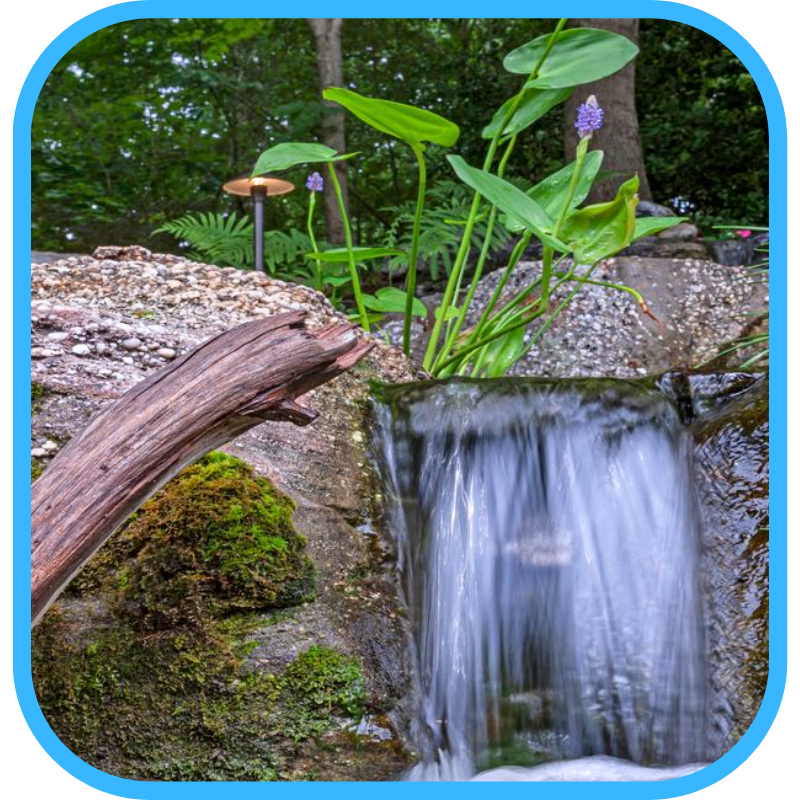
Then you add aquatic plants.
Plants pull out nitrogen. They pull out phosphates. They provide shade. They reduce stress in the water. They increase your closeness to what actually happens in nature.
All of this together is what makes it work.
You're filtering water organically the same way it happens on Mother Earth.
Could you spend a lifetime learning about plants, fish, biology, plumbing, and pumps?
Absolutely.
Each part of a water feature can make you an expert.
But you don't need to drown in the details.
Are Ecosystem Ponds High Maintenance?
Everybody's opinion of "high maintenance" is different.
The easiest way for me to answer that is to tell you what our team actually recommends and what we do for the ponds we care for.
With our ecosystem ponds, we typically do a full cleaning in the spring. We do a fall maintenance where we cut all the plants back and prepare everything for winter. There's a whole process to that.
Throughout the summer, realistically, the average pond takes about 20 minutes a week to take care of.
Could you spend more time on it?
Absolutely.
You could be a fanatic and spend half your Saturday out there if you wanted to.
And I also know plenty of people who barely touch theirs.
It's kind of like how clean you keep your house.
Some people are clean freaks.
Some people are definitely not.
It's the same way with an ecosystem pond.
If you really want to dig into the nuts and bolts — spring cleanings, fall maintenance, electrical costs, long-term upkeep — I've written an entire blog on the true cost of owning a water feature. That'll give you the full breakdown.
Read: The True Cost of Owning a Water Feature →
But in a nutshell?
A water feature is less work than a garden or a flower bed of the same size.
I work harder on my gardens than I do on my water feature.
More hours are spent pulling weeds and trimming plants on land than they are maintaining the water.
That's the honest answer.
Additional Considerations With Traditional Koi Ponds
I'm not against traditional ponds. They have their place, and they're wonderful for the right people.
But there are a few realities to consider.
Another issue can be concealment.
Traditional ponds often have external pumps and filters that need to be hidden. They can be noisier. They require more intentional design efforts to disguise.
That doesn't make them bad. It just means they need more thought on how to place them in the layout.
And then there's blending.
Because traditional ponds are more formal and fish-focused, they don't always disappear into the landscape as naturally. You can landscape around them beautifully, but you don't mimic nature in the same way an ecosystem pond does.
That's really it.
They aren't wrong. They're just built for a different purpose.
An educated person will choose the one that's best for them.
Frequently Asked Questions About Ecosystem Ponds
Q: Are ecosystem ponds safe for koi?
Yes. Koi thrive in ecosystem ponds when properly designed. However, if your goal is raising championship show koi, a traditional pond may be better suited.
Q: Do ecosystem ponds require electricity?
Yes. They rely on pumps and filtration systems to circulate water, just like traditional ponds.
Q: What happens if the power goes out?
Traditional koi ponds depend heavily on external filtration systems. Ecosystem ponds distribute biological activity throughout the rocks, gravel, plants, and filtration system, which can make them more forgiving during short outages.
Q: Are ecosystem ponds high maintenance?
Most of our clients spend about 20 minutes a week during the season, plus a spring clean-out and fall maintenance.
Q: Are ecosystem ponds more expensive than traditional ponds?
They may require more natural materials like rock, gravel, and plants during installation. Long-term cost depends on how intensively you maintain them and what features you choose.
Is an Ecosystem Pond Right for Me?
That's really just a question of what's important to you.
What kind of person are you?
What sort of experience are you looking for?
If you're a fish fanatic and you want to raise championship koi and take them to shows, you need a traditional pond. If you're going for a more formal look or love old Japanese-style koi ponds, you may lean in that direction.
And there's always the potential to blend styles together. If you find the right contractor, you can mix ideas and build something that borrows from both philosophies.
For example, I have an ecosystem pond designed for swimming, and I have big, massive, beautiful koi in it. In some ways it's a hybrid because I have external pumps due to the swimming function. The reality is, I'm never going to take my fish to a koi show. I don't care if they lose a scale or get a little beat up during a spawn.
I'm happy with my fish behaving like fish.
I want them digging in the gravel. I want them to be living in a natural environment.
That's what matters to me.
If you want something that looks like it was pulled off a mountainside — something that blends into your landscape and feels organic — an ecosystem pond is probably right for you.
The cost of maintenance (or sweat equity) on an ecosystem pond is a little more in the long term because of a needed spring clean-out. In comparison, traditional koi ponds with bottom drains can make waste removal more mechanical and streamlined without the need for drain and cleans.
But to me?
The look is worth it.
For all the things that are important to my heart, the ecosystem pond is the clean, definitive answer for what's best for me.
The real key is this:
Think through your priorities.
Look at all the options.
Pick the one that fits you.
And if you haven't made up your mind yet, there's a lot more information available. Our learning center and YouTube channel are packed with 30 years of experience building water features. We share what we've learned because we genuinely want you to end up with the right water feature for your life.
And if you don't want to sort through all of that on your own, just start a conversation.
Schedule a call. Talk to a real human.
No pressure. No used car salesman tactics. Just an honest conversation to see if we're a good fit and to help you end up with the water feature of your dreams.
Start a Conversation
No pressure. No used car salesman tactics. Just an honest conversation to see if we're a good fit and to help you end up with the water feature of your dreams.
Start a Conversation →