The True Cost of Water Feature Ownership
Written By: John G Adams
Approximate Read Time: ~18 Minutes
What Ongoing Costs Should You Expect After Installation?
“I was with a client the other day, and his wife told me that he was absolutely shocked at what it took to maintain his water feature after it was completed. I thought to myself: “Holy cow, what a great idea for an article!”
We are going to cover everything you need to know about costs associated with owning and maintaining a water feature AFTER YOU’VE BOUGHT IT so you have a crystal-clear understanding of what it takes—in sweat equity and-or in dollars—to maintain and keep your water feature running optimally. Because I like all surprises to be good surprises.
What On-Going Costs Will We Cover in This Guide?
First of all, the last thing I want is for you to think I’m steering you away from water feature ownership. I’m just getting real with you — this is information so you’ll be crystal clear on what to expect after you write your last check for the construction of your water feature.
Here are the main areas we’ll cover in this guide:
- Ongoing Maintenance: What’s required season by season, and how much time it takes.
- Maintenance Products: The everyday supplies like bacteria, clarifiers, and fish food.
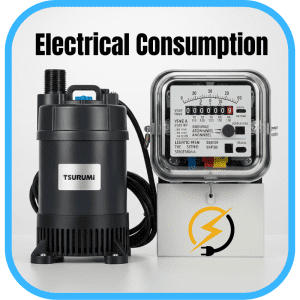
- Electrical Consumption: The impact of pumps and lighting on your power bill.
- Wear-and-Tear Items: Parts such as pumps, valves, and lights that eventually need replacing.
- Hidden or “Gold Nugget” Expenses: The add-ons most pond owners choose — from lilies to koi to patios.
I love my water feature, and I want you to love yours too. My goal is for you to have the full picture so there aren’t any surprises you weren’t ready for.
How Much Time (and Money) Does Water Feature Maintenance Really Take?
Every water feature — whether a pond, waterfall, or fountain — requires maintenance. The good news? It’s not as overwhelming as people imagine, and in many cases it’s less work than caring for a garden bed of the same size.
Here’s what the seasonal rhythm looks like:
What Will I Need To Do For A Spring Cleaning?
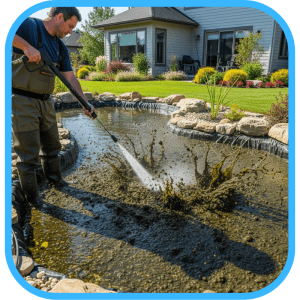
Just like your house, your water feature needs a deep clean once a year. For a typical ecosystem pond this takes a homeowner about a full day of sweat equity. Obviously, smaller features take less time and larger features take more. You can DIY or hire professionals like us.
👉 The easiest way to estimate what professional cleaning will cost is by using the Maintenance Calculator on our website. Plug in a few simple details about your water feature, and it will give you a ballpark price for having us clean it.
Want to see how we do it? We’ve got full “how we clean” videos for:
Ponds
Waterfalls
Fountains
Wetlands
How Long Will WEEKLY ROUTINE MAINTENANCE Take?
On average, expect to spend 15–30 minutes per week keeping a 200–250 square foot water feature pristine. Some people spend more, some less, depending on how finicky you are.
How Long Will FALL MAINTENANCE Take?
Similar to spring, but focused on preparing for colder weather. This usually takes 2–4 hours. The actual time depends on:
- How many aquatic plants you have.
- Whether you included tropicals (in our region, they don’t come back, so we remove them completely).
- Whether you install a net to capture leaves and deter predators.
We’ve got short and long videos that walk through fall pond cleaning, plant care, and preparing your fish
Will I Need To Do Any WINTER MAINTENANCE?
Plan on a quick 15–20 minute inspection a couple of times during the winter. This simple habit can prevent costly issues from creeping up. Again — totally doable DIY, or you can have a pro handle it for peace of mind.
And for homeowners who want to skip the sweat equity entirely, we offer a “hands-free service” through our VIP program. That means full professional care, so all you have to do is relax, enjoy, and connect — with your people and your spiritual side — while your water feature is cared for.
What Products Do You Need to Keep a Water Feature Healthy — and How Much Do They Cost?
Once your feature is built, using a few specific products — depending on the type of water feature you own — will take the spring maintenance you’ve already done to the next level. A powerful spring cleaning sets you up for a season of success, and the right products make it much easier to keep your water feature looking pristine.
What Are The Core Consumables I Will Need For My Water Feature?
- Beneficial bacteria and enzymes → Break down organics naturally and reduce sludge.
- Clarifiers and algaecides → Keep water clear and algae under control.
- Dechlorinator / water conditioner → Needed only if you add tap water to a pond with fish.
- Fish food & pond supplies → If you keep koi or other fish.
- Aquatic plant fertilizer → Optional, for water lilies and other plants.
- UV lamps → For ponds that use UV clarifiers; bulbs need replacing every 12–18 months.

Which Products Are Specific To Ponds, Fountains, Or Waterfalls?
- A pond owner may use all of the above.
- A pondless waterfall owner may only need clarifiers/algaecides.
- A fountain owner might rely on just clarifiers.
Cost range table (general guidelines):
| Product | Typical Range | Notes |
|---|---|---|
| Beneficial bacteria & enzymes | $5–$25 per month | Depends on size & concentration |
| Clarifiers/algaecides | $5–$20 per month | More use during heavy algae seasons |
| Dechlorinator | $5–$20 per month | Only needed in ponds with fish |
| Fish food & pond supplies | $5–$20 per month | Depends on number and type of fish |
| Aquatic plant fertilizer | $10–$25 per season | Optional — only if you fertilize lilies |
| UV lamp replacement | $70–$150 every 12–18 months | Only if your pond uses UV filtration |
What Are Some Trusted Brands I Can Look To? (based on independent online research, not MDA endorsements):
- Aquascape, Inc. — broad line of pond treatments and supplies.
- EasyPro Pond Products — bacteria, clarifiers, pond treatments.
- Atlantic Water Gardens — pond treatments and seasonal supplies.
- Laguna Pond Supplies — fish food and conditioners.
So How Can I Be Sure Which Products I Need For My Feature?
The exact products you’ll need — and how much you’ll spend — depends on your feature type, your goals, and your priorities. Some products are more cost-effective in bulk (like dry bacteria), while others are designed for convenience (like refill pouches for auto-dosers). It really comes down to whether saving money or saving time matters more to you.
If you’re not sure which products make sense for your water feature, reach out and we’ll help you sort through the options. And remember: the better your spring cleaning, the less product you’ll need through the season to keep things looking right.
Products are only one part of the equation. Once you cover routine maintenance, you’ll also need to think about the electricity it takes to keep your water feature running every day — and that’s where we’re headed next.
How Much Will Your Water Feature Add to the Power Bill?
I don’t know why nobody addresses the elephant in the room: pumps use electricity. And the way your water feature is designed is going to affect your power bill. The cost is totally dependent on your pump size, efficiency, and your local electrical rates.
Does The Type Of Pump Make A Difference In Power Consumption?
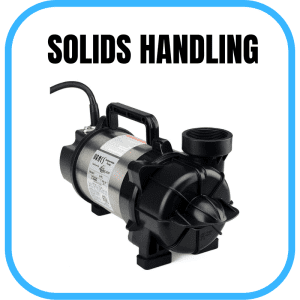
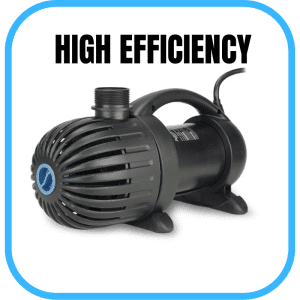
- Pumps that are highly energy-efficient often require more frequent cleaning. See the pump housing in the image below? That requires more regular cleaning and clogs faster than the opening on the Solids Handling pump on the left.
- Pumps designed as solids-handling powerhouses can chew through debris and need less maintenance, but they burn more electricity and have the potential to “grind” up small creatures if they’re not properly installed.
How do I decide which pump is the better choice for me?
Ask yourself an honest question:
👉 Are you the person who would rather save money and do more maintenance?
👉 Or are you the person who would rather pay more on the power bill and spend less time cleaning?
What Is A Typical “Daily Cost Of Operation” For My Water Feature? (as of late 2025):
- Average residential pond: about $1–$2 per day.
- My own swim pond, for example: closer to $8 per day.
That number could have been much higher, or I could have designed for lower. It depends on the choices you make. Features designed for magnitude, like mine, use more energy. Features designed for efficiency can cost far less. Design with intention — because efficiency and “over-the-top” flow rates or waterfall heights usually live at opposite ends of the spectrum!
Landscape lighting: adds about $1.50–$5 per month.
Can I Calculate My Exact Electrical Usage?
- Find your pump’s wattage (listed on the unit).
- Multiply by the number of hours it runs each day (most are 24/7).
- Divide by 1,000 to convert watts into kilowatts.
- Multiply by your utility’s kWh rate (usually 10–20¢ per kWh in most U.S. markets).
That gives you your daily and monthly costs.
How Can I Manage My Power Costs?
- Pump efficiency matters. Today’s high-efficiency pumps can cut costs in half compared to older models.
- Right-size your pump. Oversized pumps waste money. Get one that matches your feature’s volume and design.
- Optimize with party pumps. Run your main feature at efficient levels 24/7, then flip on a booster when you want to impress guests.
- Smart timers for lighting. Let lights run when you’re outside enjoying the feature, not all night long.
Electricity is the silent, steady cost of owning a water feature. Once you know your pump and lighting numbers, there won’t be surprises on your power bill. But remember — it’s not just about the math. It’s about how you design, and whether you value efficiency or big water-flow.
Consumable products and electricity aren’t the only costs related to water feature ownership. Regional considerations can also come into play.
Are There Differences in Maintenance Costs Based on Your Climate And Region?
One of the biggest variables in long-term ownership is your climate. Seasonal services change depending on whether you’re in the North, the Southeast, or farther South in the tropics.
- Northern climates (Michigan, Canada, etc.): Ponds freeze over. Owners shut down waterfalls, drain plumbing, and either use a small pump or bubbler to keep a hole in the ice for gas exchange.
- Southeast (like East Tennessee): Ponds stay running year-round. Fall maintenance is focused on cutting back plants, installing a leaf net, and preventing predator access once vegetation dies back.
- Tropical regions: No shutdowns, but service is more frequent year-round. You may avoid fall netting, but you’ll be trimming plants and keeping up with routine care nonstop.
The result? While the types of services differ by region, the overall maintenance cost tends to balance out. You may spend less in one season and more in another, but in the long run it’s fairly similar.
Where you will see a real difference is in electricity costs. In some states — California, Colorado, and others — power rates are much higher than in places like Tennessee. That can have a noticeable impact on annual ownership.
👉 Bottom line: regional climate affects what gets done and when, but the biggest long-term cost swing usually comes from your local utility rates.
That being said, there are also a few parts that eventually wear out and need some TLC. In the next section, we’ll talk about the components you’ll need to replace over time and what they’re likely to cost.
Should You Maintain Your Water Feature Yourself or Hire a Pro?
The short answer: it depends on what you value more — your time or your money.
You can save a good bit of cash by doing the work yourself, and some people even find it therapeutic. But if you’d rather spend your weekends enjoying the water than scrubbing filters, hiring a professional may be worth every penny.
Either way, the most important step is to research what level of service you’re actually getting. Not all “maintenance” packages are the same. Read reviews, look for transparency, and make sure past clients are thrilled with their results.
Is DIY Maintenance Right For Me?
- Comfortable with tools, pumps, rinsing filters, and handling basic water chemistry.
- Can budget 15–30 minutes a week during the season, plus a full day in spring for a clean-out and half a day in fall for prep.
- Prefer to spend money on materials, not labor.
- Okay with a long learning curve — water features are living ecosystems.
- Willing to get dirty. Water feature maintenance isn’t glamorous.
Is Professional Maintenance Worth It And What Does It Include?
- Full spring cleaning — Learn more here
- Mid-season visit to keep things in check.
- Fall service & netting — helps protect plants and fish before winter.
- Quality reports that show what was done and flag potential improvements.
- VIP packages for true hands-free enjoyment with routine visits and bundled consumables.
How Can I Compare Water Feature Maintenance Quotes (And Know What I’m Really Getting)?
When comparing providers, don’t just look at the price. Ask:
- Do they show exactly what their clean-out process includes (photos, videos)?
- Are visits performed by trained technicians — not just “yard guys”?
- Are consumables included or billed separately?
- What’s their fish-handling protocol (if you keep koi or goldfish)?
- Do they sanitize equipment between jobs to prevent cross-contamination?
- Will they handle pump warranty claims for you?
- Do you get a photo report after each visit?
- Are they licensed and insured?
👉 Cost clarity matters. If you want to know what Modern Design might charge for water feature maintenance, use our maintenance estimator. You can also explore hands-free ownership plans there.
What Parts Wear Out on a Water Feature (and What Do They Cost to Replace)?
Just like a car needs brakes and tires, every water feature has components that eventually wear out. Typically in the “replaceable” items there are three main categories we think about: pumps, valves, and electronics / lighting. How you design, install, and maintain your feature will impact how long each lasts — but eventually, these parts will need repair or replacement.
Pumps — the heart of your water feature
- Lifespan: usually 3–5 years.
- Warranty: typically 1–2 years.
- Replacement cost: DIY can be $500–$1,500; professional replacement usually runs $1,500–$2,500.
👉 Pro tip: If you save money by buying a pump online, don’t expect your installer to become your technical advisor. Whoever sells it to you should be the one responsible for troubleshooting and warranty support.
External vs. submersible pumps:
- Submersible pumps are quiet, easy to hide, and quick to install — but usually less repairable.
- External pumps are louder and harder to disguise, but they’re often more energy-efficient and more repairable.
- If your pump fails and you don’t have a backup, you’ll lose biological filtration quickly. Always keep an aerator on hand as an emergency oxygen supply for fish. If you keep expensive koi, having a backup pump is non-negotiable.
Check valves — small part, big consequences
Check valves prevent water from back-flowing when the pump shuts off.
- When a check valve fails, consider it a heart attack for your pump.
- It’s like leaving your car screaming down the interstate in first gear — it doesn’t take long to explode.
- Lifespan: varies, but all fail eventually.
- Replacement cost: around $100 DIY; about $250 professionally.
Lighting and electronics
Every light burns out eventually, and electronics add another layer of upkeep.
- LEDs and halogens: usually last 3+ years.
- Manufacturer warranties can range from 5 years on submersible lights to lifetime on some landscape fixtures.
- Replacement cost: under $100 for a warrantied submersible fixture; around $350 if it’s out of warranty and replaced professionally. DIY can be closer to $150 per fixture (if you’re ready to scuba dive).
Other electronic wear-outs to keep in mind:
- Transformers (which run your lights) — some lifetime warranty, some only a year.
- Timers — fail occasionally, and their batteries need replacement.
- Fancy pump controls — variable speed pumps and remote controls are great, but when they break, they’re more expensive to replace. The more tech you buy, the more it costs to fix later.
What does all this mean for you?
Everything above is an estimate. Lifespans vary based on quality, maintenance, and design. Take good care of your equipment and you’ll usually get more years out of it — but remember, the more complex and “fancy” you go, the more you’ll pay to maintain that fancy down the road.
Think of these as the brakes and tires of your water feature. You don’t need to replace them every season, but eventually, the bill will come due.
Quick Reference Table — Wear-and-Tear Parts
| Component | Typical Lifespan | DIY Cost | Professional Cost |
|---|---|---|---|
| Pump | 3–5 years | $500–$1,500 | $1,500–$2,500 |
| Check valve | Varies, all fail eventually | ~$100 | ~$250 |
| Lighting (LED/Halogen) | 3+ years (warranty varies) | ~$150/fixture | ~$350/fixture |
So far we’ve looked at consumables, electricity, and wear-and-tear parts. But there’s one more category most people don’t plan for: the hidden costs and lifestyle add-ons. Once you start living with a water feature, it has a way of inspiring patios, plants, and koi collections that keep the investment going. That’s what we’ll cover next.
What Lifestyle Add-Ons Should I Expect To Want After The Fact?
You know, I often compare owning a water feature to owning a fish tank. You start out with a little 10-gallon tank, then move up to a 30, then a 55… and so on. Water features can be the same way.
I call mine my water feature addiction. I even joke that I carry a “pond mortgage.” When I pay it off, I just use that line of credit to create some other amazing thing in my outdoor living space.
Even though my addiction may be far beyond what most people experience, I’m not the only one who’s continued to feed the habit. Once you have a pond, there are a few “optional joys” that almost every water feature owner ends up investing in:
Should My Water Feature Include Patios, benches, and flowerpots?
The further away from your house you build your water feature, the more this comes into play. Because once it’s finished, you’ll realize you want to get up close and personal to enjoy it.
Will I Want Tropical Plants In My Feature?
In Tennessee, tropicals don’t survive the winter. They need to be replaced, but I’ve found some of the most enjoyment in creating a Jurassic Park feeling in my waterfall with them. They can totally transform the space.
Should My Pond Have Water Lilies In It?
Lilies need to be repotted and fertilized each season to maximize blooms. You can get basic hardy lilies online for $15, or you can go next level with inter-subgeneric (ISG) lilies that combine the habits of tropicals and hardies. I’ve even bought a lily for $500. Like everything else, it’s as crazy as you want to make it.
How Much Will I Need To Spend On Fish For My Pond?
From mutts to pedigrees — I love that line. I’ve bought koi for free, I’ve bought them at PetSmart, and I’ve flown to Japan and paid $3,000 each for pedigreed fish. At this point, feeding heavily in summer, I can go through more than a 25-pound bag of food every week.
Should I Expect To Need OutDoor Furniture?
Want to sit out by your feature? Rockers at Home Depot might cost $200 each. The ones by my pond cost $1,000 each. Patio furniture, fire pits, grills, even entire outdoor kitchens often follow once the feature becomes the centerpiece of your yard.
This part of the story isn’t about “hidden costs” as much as it is about optional lifestyle choices.
This isn’t just about money. It’s about lifestyle psychology. Your water feature becomes the heartbeat of your outdoor space — a living habitat for people and animals. You can swim in it, wade in it, explore it. Kids catch frogs, tadpoles, and minnows. I even have native rainbow darters in my wetland filter that reproduce naturally.
This is where you escape the digital nightmare of the world and reconnect. It’s not a cheap hobby, and I’m not pretending it is. But it is a rewarding one. And ultimately, what you choose to add is completely up to you.
Quick Reference Table — Potential Costs For Water Feature Add-On’s:
| Add-On | Low Range | High Range | Notes |
|---|---|---|---|
| Patio | $2,000 | $25,000+ | Small DIY setups vs. large 600 sq ft paver patio |
| Tropical plants | $20 | $500 | Annual replacements; boutique vs. Amazon pricing |
| Water lilies | $50 | $500 | Basic hardy vs. rare inter-subgeneric hybrids |
| Fish (koi, etc.) | $25 | $10,000 | PetSmart mutts vs. pedigreed Japanese koi |
| Patio furniture | $250 | $4,000 | Entry-level vs. premium outdoor sets/rockers |
So far we’ve covered maintenance products, electricity, wear-and-tear parts, and the optional joys that can take your space to the next level. There’s just one big topic left — the difference between lifetime costs and the initial price tag. That’s where most people get blindsided, and that’s where we’re going next.
What’s the Lifetime Cost of Ownership Compared to the Initial Price?
Guys, you buy the thing — and everybody looks at the cost of a water feature. First, they’re shocked at the build price. Then they ask, “What does it cost to maintain?”
Most people expect that when you buy something nice, it costs money to keep it up and take care of it. Cars, boats, pools — anything that’s a luxury item requires ongoing costs.
Every once in a while, I run into someone who thinks a pond or waterfall is maintenance-free. I don’t know where that idea comes from, but let me be clear: this is not a George Foreman grill. You don’t set it and forget it.
This isn’t about scaring anybody. It’s worth every dime. Best money you’ll ever spend. If you’re like me, you’ll enjoy it more than anything else you’ve ever done. My goal is that it’s not a surprise.
How Much Does It Cost to Build One in the First Place?
Most people focus only on the build price. How much does it cost to install a pond, waterfall, or fountain?
We’ve already created deep-dive articles that answer this with complete transparency:
On top of that, we’ve built Project Profile Pages for real jobs we’ve done. These show the story, the challenges, the client goals, and the actual costs in today’s dollars:
Video, text, photos — however you like to learn, it’s there.
What Will You Spend Each Year to Keep It Running?
Once the feature is built, you’ll have a few layers of ongoing cost:
- Consumables (Section 4): bacteria, clarifiers, dechlorinator, fish food, fertilizers, UV bulbs.
- Electricity (Section 5): pumps running 24/7, lighting at night.
- Wear-and-tear parts (Section 6): pumps, check valves, lighting, transformers, timers, electronics.
- Optional joys (Section 7): patios, lilies, koi, tropical plants, furniture, and whatever else your hobby inspires.
👉Ballpark annual ownership costs: for most small-to-midsize, professionally installed features, expect roughly $600–$2,000 per year; very large or less-efficient builds can run higher (swim ponds are outside this range).
It’s no different than owning a car. You pay for gas, oil, tires, and brakes — not because you didn’t expect them, but because that’s part of the deal.
Annual Ownership Cost Table for Professionally Installed Water Features (DIY Maintenance, 2025-2026)
These ranges reflect typical small-to-midsize professionally installed features (ponds ~100–300 sq. ft.; pondless waterfalls with vaults, 2″ plumbing, and professional-grade pumps in the 3,000–5,000 gph range; and professional-grade fountains). Costs assume you handle your own maintenance.
| Feature Type | Consumables | Electricity | Pump Only (Amortized, 4 yrs) | Total Annual Ownership (DIY) |
|---|---|---|---|---|
| Pond (100–300 sq. ft.) | $100–$400 | $365–$730 | $175–$250 | $840–$1,380 |
| Pondless Waterfall (3,000–5,000 gph) | $50–$150 | $365–$1,095 | $175–$250 | $590–$1,495 |
| Fountain (Professional grade) | $50–$150 | $365–$730 | $175–$250 | $740–$1,130 |
Note: Add approximately $150 per year if your feature includes lighting (average replacement of one submersible fixture per year).
Professional maintenance is not included in the totals above.
Is Owning a Water Feature Really Worth the Ongoing Costs?
I can’t emphasize enough how much joy I’ve gotten from my water feature. I could have bought just about any water feature on earth for what I’ve spent on ours — between the feature itself, the patios, and all the extras. But I’ve never regretted a single dime.
In fact, I keep dreaming up new ways to make it better: adding an all-season area, building a deeper swim hole so I can jump in without stressing my fish. My dream never stops. It’s my passion in life.
Some people have a race car addiction. This is mine. And if you love the outdoors, I highly recommend bringing some of this magic into your world.
Frequently Asked Questions About Water Feature Costs & Maintenance
Do water features increase my water bill?
No, they shouldn’t. Most water features are closed-loop systems. You’ll add a small amount of water occasionally for splash or evaporation, but if you see a big spike in your bill, something’s wrong. Most often it’s a low liner edge or a malfunctioning autofill valve creating a constant slow leak. Fix that and the bill goes back to normal.
Can I shut my pond, waterfall, or fountain off when I’m on vacation?
For ecosystem ponds, the answer is no. The pumps that run biological and mechanical filters must run continuously or the system dies. Party pumps (extra pumps you run for effect) can be shut off, but the main circulation pump cannot.
For pondless waterfalls and fountains, you can shut pumps off — but beware. If aquatic plants dry out, they’ll die. And a feature without moving water becomes a playground for critters like squirrels or chipmunks, who can chew holes in liners. Best practice: leave it running.
How often do pumps really need replacing?
Most submersible pumps last 3–5 years. With perfect conditions — protected by a skimmer box and running at the right head pressure — some pumps last a decade or longer. But the safe bet for budgeting is five years.
Will my pond attract mosquitoes?
No. Mosquitoes need still water to breed. Moving water discourages them. In fact, most mosquito problems come from damp garden beds or ground cover — not from a healthy pond, waterfall, or fountain.

Can a water feature be moved if I sell my house?
Not practically. Moving the fish is possible, but moving the actual water feature usually costs more than building a new one. The smart move is to design your new space with a fresh build instead of trying to relocate the old one.
Will a water feature increase my property value?
It depends. Some buyers see a water feature as a dream come true; others see it as a maintenance headache. The real value is what it adds to your life: peace, relaxation, connection with family and nature. If you’re looking for ROI in resale dollars, a water feature isn’t a guaranteed strategy. But if you’re looking for ROI in joy and quality of life, it’s one of the best investments you can make.
How long does a pond liner last?
It depends on the material and how well it’s protected from the sun. Cheap, plastic-bag-style liners may fail in a few years. High-quality EPDM liners, installed correctly and covered with rock and protective underlayment, can last decades. I’ve personally uncovered a 25-year-old liner that was still fresh and pliable. Done right, an EPDM liner should outlast most of us.
What happens to a pond or water feature in the winter?
It depends on your region.
- In cold climates (Michigan, Canada), ponds and waterfalls get shut down and winterized. Plumbing is drained, and pumps or bubblers are used to keep a hole in the ice for gas exchange.
- In East Tennessee and similar climates, we keep features running year-round. Fall service focuses on plant cutbacks and leaf nets.
- In tropical climates, you skip winterization but handle more frequent year-round maintenance.
Fountains are the one area to watch: if water freezes in a basin, it can crack the structure.